Showing posts with label drawing conclusions. Show all posts

Tuesday, June 11, 2013

Speed dating

This is my adaptation of the popular speed dating activity for the classroom. (Just search for the term and you'll find plenty of information.) My idea originated with a video on the Teaching Channel website. The video shows a creative way of using paint chips to encourage the use of new vocabulary in class discussions. I took speed dating and paint chips and came up with the following activity to review concepts in 1984:

I developed groups of questions around important concepts in the novel. The questions were of varying levels of difficulty, covering the range of Bloom's taxonomy. On paint chips (I used Olympus chips with three colors, but you can use any brand*), I arranged three questions in increasing order of difficulty. Here's a snapshot of what the cards looked like:
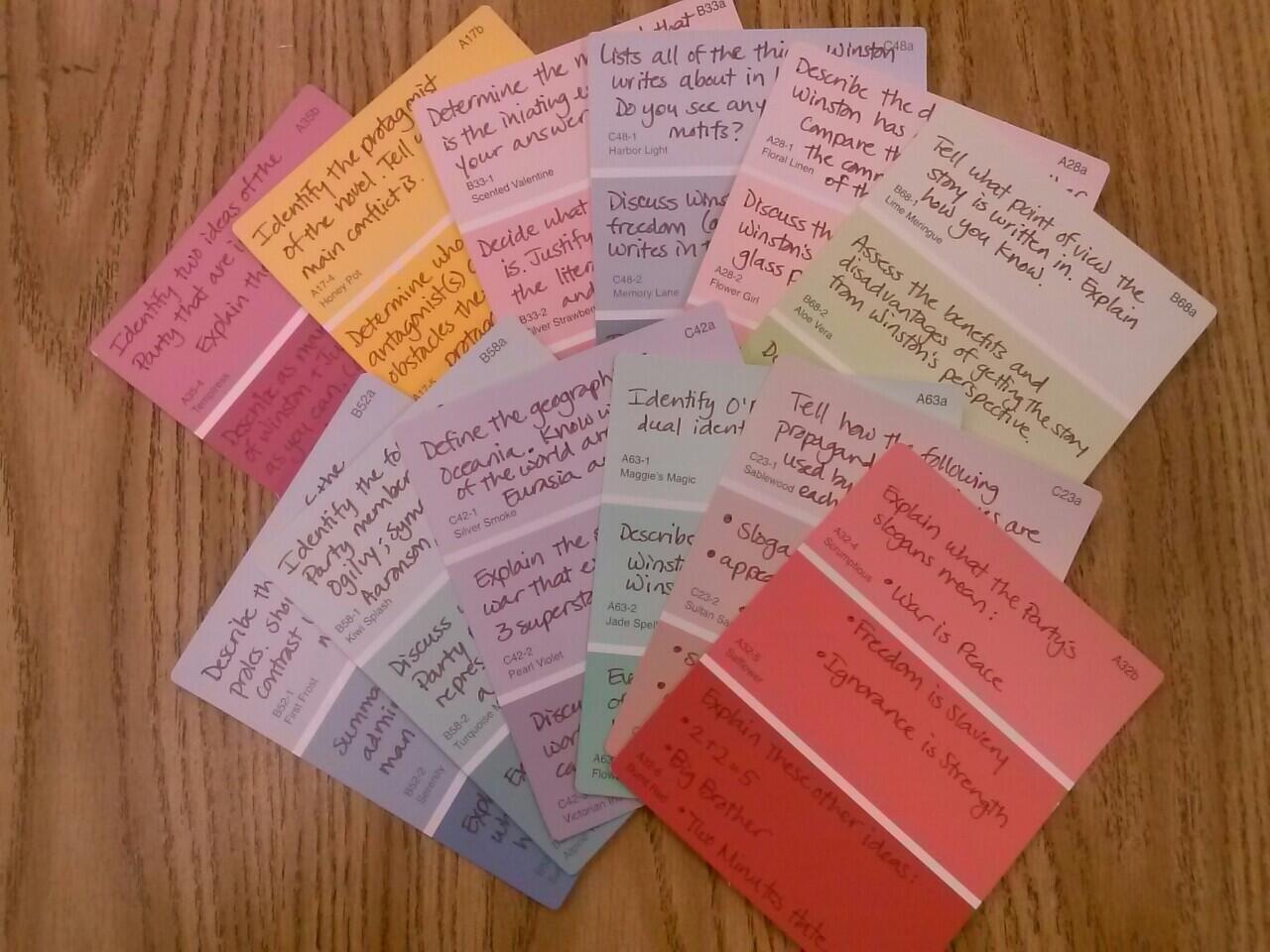

(For some cards, I cheated and had only two levels because I couldn't think of a synthesis or evaluation question. That's something to work on for next year.)

I arranged the desks into two concentric circles with the outside circle facing the inner circle. (I have 24 students in the class, so the pairing worked out evenly. I only had to create 12 cards.) The inner circle stayed put, and the outer circle rotated at the end of each round. To start, each pair was given a card to discuss for 4 minutes; as they answered the questions and talked about the topic, they took notes about how knowledgeable their partners were and what new insight they gained from the discussion. At the end of the round, the outer circle moved one seat clockwise, and the inner circle passed the card one seat counterclockwise. This ensured that the both partners in the new pair would get new questions. They continue in this way until the 6th round--it gets tricky here because the outer circle will get around to a card they've already seen. I just had the inner circle pass one more time, which seemed to get them back on track with new cards.

At the end of the activity, I asked students to review the notes they took and fill out a ballot telling me who would be their "ideal date"--e.g. who was the most knowledgeable and provided you with the most new insight. We went over all of the questions as a class. The students turned in their notes at the end. I looked over the notes to see if there was any misinformation; otherwise, I gave them credit for participating and taking notes.

Reflection: The students said this activity was really helpful because they got to share their ideas in a safe environment. The quiet ones did not feel intimidated because they only had to share with one person at a time, and the dominant speakers had to learn to share the time with their partners. They enjoyed being able to discuss more intimately with classmates they normally didn't talk to.

If you try this, please let me know how it goes!

Wednesday, June 6, 2012

1984 by George Orwell

You can now find my materials posted in my store.

Here are the activities I use with 1984:

  • Foundations - This activity asks students to record and review details, make predictions, and draw conclusions about several characters, concepts, and topics from the opening chapters of the novel. It helps students build a foundation on which to begin their understanding of the novel. Topics include Winston, Big Brother, thoughtcrime, women, and history.
  • Writing Assertions - Students practice generating an assertion, providing relevant and appropriate evidence, and writing thoughtful commentary. This activity may be used at any point in the novel. Available in my store!
  • Animal Imagery - Students analyze Orwell's use of animal imagery and explain the significance of it. They look at how diction creates positive and negative connotations. Use this activity at the end of Book One. Available in my store!
  • Diction Activity - Students examine Orwell's diction in several passages. Specifically students analyze how the use of certain words affect characterization and imagery. Students do this by choosing the three most important words in the passage and finding appropriate dictionary definitions for the words. Then they explain why they chose these words by discussing their connotations in relation to the conflict, mood, and themes of the novel. Available for free download here.
  • Paired Scenes Analysis - Use this matrix to compare and contrast two pairs of scenes: Winston's two dreams about his mother (in the subway and eating chocolate), and Winston's two experiences with O'Brien (Two Minutes Hate and meeting in apartment). Students practice drawing conclusions based on evidence. Available in my store!
  • Parallels to the Fall of Man - Use this matrix to compare and contrast Winston and Julia's relationship to Adam and Eve's. This activity encourages students to organize their thinking and analysis in the assertion-evidence-commentary model. Available in my store!
  • Parallels to Contemporary Politics - This activity is particularly relevant, with the recent focus on North Korea. Students read an excerpt from the book Escape from Camp 14 by Blaine Harden to discuss the similarities to Winston's experience in Room 101. The worksheet directs students to focus on certain sensory experiences to draw conclusions about fear, pain, and power.
  • Study Guide - A comprehensive study guide helps students with characters, setting, ideas/concepts, conflicts, and themes in preparation for a multiple choice exam. Available for free download here.